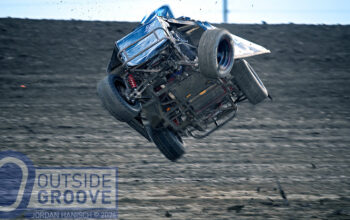
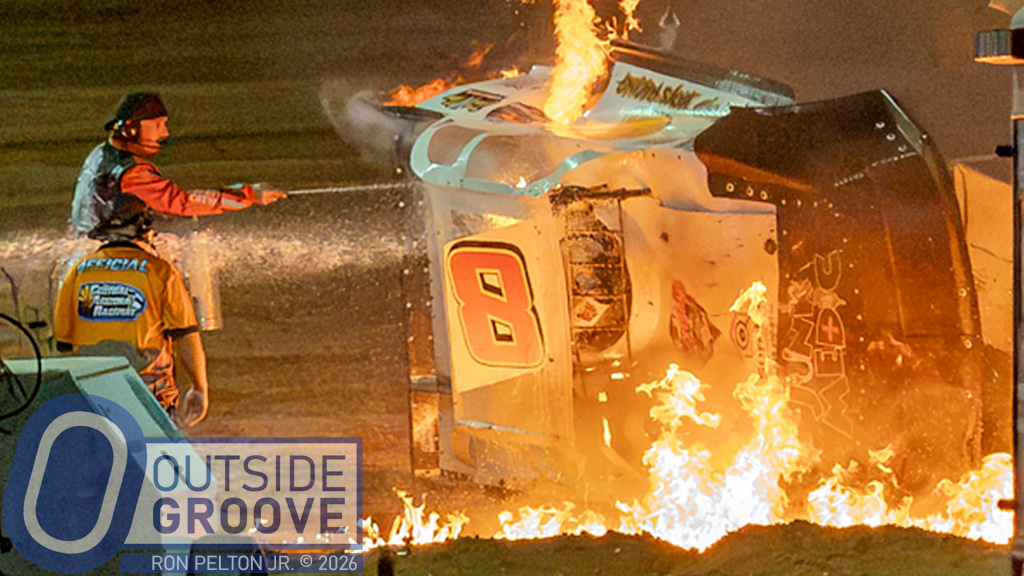
Fire engulfed the mini late model of John Boyd on Friday. Surprisingly, he came back to next day and won his heat race the next day.
Boyd ran in fourth during the feature at Deuce of Clubs Thunder Raceway. While battling for position during the feature, the leader, Chris Rasta, spun. It collected the cars behind him, including Boyd’s. After Boyd slid into the leader, his car rolled over and landed on its roof.
“I was strapped into the seat, upside down,” Boyd, of Globe, Arizona, said. “As soon as the wrecker began turning me over, I smelled fuel. In a second, the entire car was engulfed in flames.”
Boyd said time felt like it stood still.
“I thought about everything I could do to get out of the car,” Boyd said. “I released my belts and was thinking I did not want to fall forward. As I tried to pull myself out, I felt someone grab me by the helmet. As soon as I got my shoulders out, the track crew pulled me to safety. I rolled on the ground to make sure I wasn’t on fire.”
Boyd sat in a Kirkey full-containment seat, with a Zamp five-point harness. He wore a Summit Racing Equipment helmet paired with a Zamp head-and-neck restraint. Boyd sported a brand-new Move Racewear fire suit, purchased just before the weekend.
He did not wear a balaclava (aka head sock) or helmet skirt, so flames entered underneath his helmet. Boyd also lifted his visor just before the fire erupted, with flames entering that point, too. He suffered first-degree burns to his neck, face and head, and the fire singed his mustache, eyebrows and hairline. Nevertheless, he returned the next day to the track.
His team could not conclusively pinpoint the cause of the fuel leak, but felt it might have been the seal around cap of his Jegs fuel cell. They stayed at the track until 2:30 a.m. to remove the car’s damaged front axle and kingpins, and then made a list of items they needed to race.
“We took a nap and was at Ace Hardware when they opened at 8 a.m.,” Boyd said. “We got bolts and bracing and then it was hammer down to be ready for Saturday night’s race. And we got a gasket for the fuel cell cap.”
He also bought Simpson fire-retardant socks and a balaclava, the latter of which to prevent fire from entering his helmet once again, along with a new pair of gloves.
“We replaced all the fuel lines in the car and the wiring, injectors and fuel pump regulator on the GSX-R600 engine,” Boyd said. “By 4 p.m. on Saturday we were putting the panels and nose piece back on. We made the 5:30 drivers’ meeting and went out and won the heat race with no practice laps. We started outside pole on the feature, but the car quit in the third turn — we had to call it a day at that point. It had to be the fuel pump malfunctioning.”
John Boyd couldn’t express enough his appreciation for those who helped him get through the weekend. That included Rasta, who bought him a new set of belts, telling Boyd he wanted to keep him safe by not using burnt belts.
Mike Adaskaveg has written hundreds of stories since the website’s inception. This year marks his 54th year of covering auto racing. Adaskaveg got his start working for track photographer Lloyd Burnham at Connecticut’s Stafford Motor Speedway in 1970. Since then, he’s been a columnist, writer, and photographer, in racing and in mainstream media, for several outlets, including the Journal Inquirer, Boston Herald, Stock Car Racing, and Speedway Illustrated. Among Adaskaveg’s many awards are the 1992 Eastern Motorsport Press Association (EMPA) Ace Lane Photographer of the Year and the 2019 National Motorsports Press Association (NMPA) George Cunningham Writer of the Year.