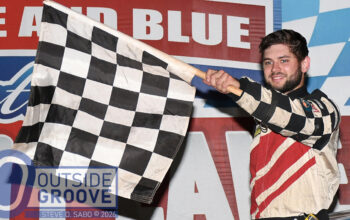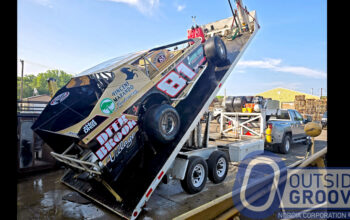

After receiving a one-month suspension from IMCA for refusing an engine claim, Matthew Looft decided to return to his old stomping grounds. Last Friday, he brought his backup IMCA sport mod to the USRA-sanctioned Fairmont Raceway, where he returned to victory lane. It’d been five years since he left that track after it switched sanctions from IMCA to USRA.
On May 30, Looft had won his 300th IMCA sport mod feature at Hancock County Speedway. Then, on June 12, after finishing fourth in the IMCA sport mod race at Kossuth County Speedway, sixth-place finisher Jake Sachau claimed his engine, which Looft complied with.
Down to his one backup engine, he raced at Hancock County Speedway on June 13. Another competitor claimed his engine, but Looft refused, leading to disqualification, a suspension from IMCA for one month, and a $1,000 fine. Looft has not returned to IMCA sport mod racing since then.
“The suspension hurt my racing, my sponsors, and the tracks I race at because the fans who follow me and cheer for me were no longer there,” Looft, of Swea City, Iowa, said. “The claim rule is a rule that is enforced, but it is not being used in the way it was designed to be used. When the people claiming the engines are well funded racers, the rule is being used as a grudge claim.”
Looft uses engine built by S & S Machine.
“I personally helped design and build my engines,” said Looft. “I like the process — experimenting with cams, running the dyno — I did nothing to cheat up my engines. What I did do is I supported my local machine shop rather than buying a GM engine from Mexico.”
IMCA instituted the claim rule to help keep engine costs down.
“Today, in 2025, you can’t race a junkyard engine and be competitive anymore,” Looft said. “Two-thirds of the field are running built engines and about one third the GM 602 crate. The rule should go away now. The IMCA stock car spec engine and the IMCA sport mod engine are virtually the same. There is no way to make them cheaper — they have to use certain parts.”
In the past month, his IMCA suspension lifted and Looft has been racing stock cars for Paul Berger. Now, he’s working with Kelly Shryock to develop a modified program. Yes, Matthew Looft will return to IMCA.
“Friday night was my first non-IMCA show since Bristol four years ago,” said Looft. “I’m taking my sport mod, making it a four-link chassis, and tuning on it as a modified.
“I was motivated to move up to the modified division, but I wanted to do it on my own terms. It got expedited — I’m doing three months’ work in a couple of weeks. I’ve got my wife Brittney’s help and support, and I have Kelly’s guidance. I’ll be back soon as a modified driver.”

Mike Adaskaveg has written hundreds of stories since the website’s inception. This year marks his 54th year of covering auto racing. Adaskaveg got his start working for track photographer Lloyd Burnham at Connecticut’s Stafford Motor Speedway in 1970. Since then, he’s been a columnist, writer, and photographer, in racing and in mainstream media, for several outlets, including the Journal Inquirer, Boston Herald, Stock Car Racing, and Speedway Illustrated. Among Adaskaveg’s many awards are the 1992 Eastern Motorsport Press Association (EMPA) Ace Lane Photographer of the Year and the 2019 National Motorsports Press Association (NMPA) George Cunningham Writer of the Year.