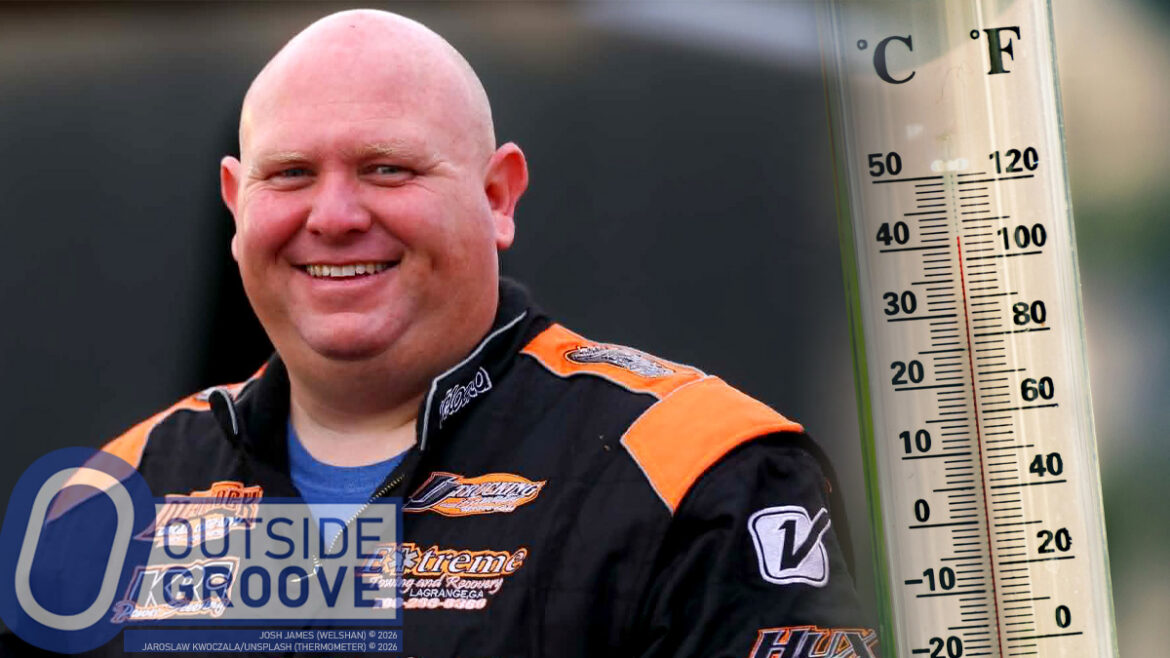
Dirt late model driver Jason Welshan found out what rhabdo was the hard way. The condition sent him from Smoky Mountain Speedway’s pits to the ER and landed him in the hospital for 3 days. Rhabdo’s a threat to all racers, especially on hot days.
Rhabdo is short for rhabdomyolysis. It affects 26,000 Americans every year. Jason had signs of it coming on before race day.
“Rhabdo is the destruction of striated muscle cells,” Jason’s wife, Leanne, an operating room nurse, said. “The symptoms are cramping, as rhabo breaks down the muscles. He started having cramps early in the week. Rhabo was setting up in his body for a couple of days.”
When those muscles break down, it sends toxic components into the bloodstream, where the kidneys have to filter it out. When the kidneys become overwhelmed, muscle cramps begin. Dehydration exacerbates the situation.
Those on medications such as statins may be more prone to the condition, as well as athletes overexerting themselves in hot weather.
“The symptoms are muscle swelling, muscle weakness, tender and sore muscles,” Leanne said. “Most important is the color of subject’s urine. When pee is dark yellow or tea color, it is an indication of dehydration and rhabdo.”
While in the infield waiting for the next B feature to complete for the Best Plumber 604 Racing Series, Jason’s symptoms got worse.
“I got out of my car, and my leg went into a major cramp,” Jason said.
Workers helped Jason across the track while the track summoned Leanne to his pit area.
“I saw it happening — Jason cramped up more and more as time passed,” Leanne said. “It went from his right thigh to his groin to his abdomen, and then his arm and hand. It was getting worse, not better.”
Jason initially refused paramedic attention. Instead he drank pickle juice, which some athletes use to help with cramps. It didn’t work.
“I made the decision that we needed to go to the ER — in the ambulance,” Leanne said. “When a nurse agrees to get into an ambulance, you know it’s serious.”
At the hospital, they drew blood to check the levels of creatine kinase, which doctors use to detect muscle damage. Levels above 200 U/L indicate a problem. Jason’s number came back in the 900s.
“The next morning, his CK was up to 952 — going up is not good,” Leanne said. “We kept pushing fluids with an IV. Sunday afternoon, he was able to stand up and urinate, an indicator that his kidneys were not shutting down, which was our biggest fear.”
On Monday, his CK levels decreased and the hospital discharged late that day. Jason’s now feeling better, but his case serves as a good lesson for all racers.
“High intensity exercise in heat, where you are constantly sweating, means you will be losing more fluids than normal,” Leanne said. “Preload your fluids, whether it is with water, Gatorade or Powerade [before a hot day at the races]. Eat lots of fruits. Take magnesium. Be proactive when you know your body will be working hard in the heat.”
Ultimately, paying attention is key — and that’s not only advice for racers, but for everybody.
“Listen to what your body is telling you,” Leanne said. “If you feel off, look at your urine color. Increase your water intake. Jason was not keeping up with the fluid intake he needed. That night, his fire suit was drenched like he was just in a swimming pool. We had an expensive and painful lesson.”

Mike Adaskaveg has written hundreds of stories since the website’s inception. This year marks his 54th year of covering auto racing. Adaskaveg got his start working for track photographer Lloyd Burnham at Connecticut’s Stafford Motor Speedway in 1970. Since then, he’s been a columnist, writer, and photographer, in racing and in mainstream media, for several outlets, including the Journal Inquirer, Boston Herald, Stock Car Racing, and Speedway Illustrated. Among Adaskaveg’s many awards are the 1992 Eastern Motorsport Press Association (EMPA) Ace Lane Photographer of the Year and the 2019 National Motorsports Press Association (NMPA) George Cunningham Writer of the Year.